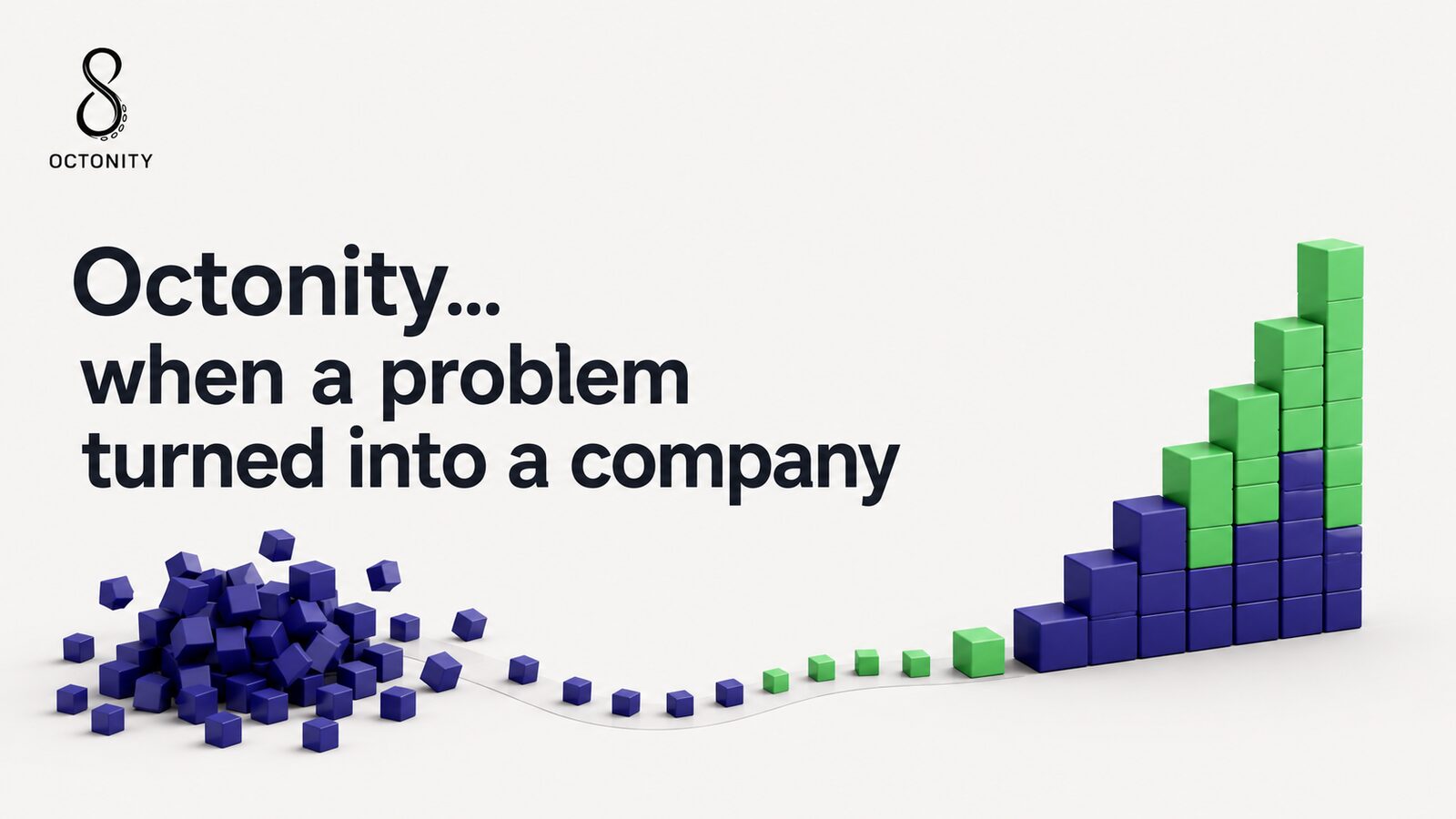
Every successful company has a beginning, and Octonity's beginning was not
a passing idea. It was the result of noticing the same problem, over and over,
that everyone managing social media accounts struggles with.
The problem that repeated itself every day
Every time I used social media management tools, I felt like the work was
scattered across dozens of platforms. One tool for publishing, another for
design, a third for replying to comments, a fourth for analytics, and a fifth
for managing the team. In the end, instead of increasing productivity, these
tools added even more complexity to the workflow.
That's where the idea started...
Why isn't there one platform that brings everything together?
Not just a scheduler, and not just an AI writer, but an integrated workspace
where users can manage all their social accounts from one place.
From idea to product
The journey of building Octonity started like any startup: long hours of
research, experimenting with ideas, and redesigning the product many times
over. The goal was never to pile on features — it was to remove the
unnecessary steps users repeat every single day.
Over time, the vision grew beyond just publishing.
Octonity became a platform that helps users:
- Manage all their social accounts from a single dashboard.
- Schedule content across every platform.
- Design images and videos right inside the platform.
- Handle messages and comments from one unified inbox.
- Use AI to create and improve content.
- Protect brands from spam and abuse with a smart comment-moderation system
that supports more than 30 languages, including Arabic and its dialects.
How does Octonity compare to the tools on the market?
The market is full of well-known social media management tools: Hootsuite,
Buffer, Sprout Social, and Later. They are good tools, and I have
used all of them myself. But each one was built to solve one part of the
problem, leaving you to assemble the rest from other tools.
Here is an honest comparison between what Octonity offers and what the
best-known alternatives provide:
| Feature | Octonity | Hootsuite | Buffer | Sprout Social |
|---|
| Scheduling and publishing across platforms | ✓ | ✓ | ✓ | ✓ |
| Designing images and videos inside the platform | ✓ built-in editor | via external integration | limited | limited |
| Unified inbox for messages and comments | ✓ on all plans | on higher tiers | limited | ✓ |
| AI for creating and improving content | ✓ built into the workflow | basic writing assistant | basic writing assistant | basic writing assistant |
| Smart comment moderation in 30+ languages | ✓ | — | — | partial |
| Native understanding of Arabic and its dialects | ✓ native support | — | — | — |
| Affordable for individuals and small teams | ✓ | expensive | ✓ | aimed at large companies |
The comparison above is based on each tool's publicly listed plans and
features at the time of writing, and may change as these tools evolve.
Why is Octonity a real alternative, not just another tool?
A Hootsuite alternative for those who want simplicity without giving up power
Hootsuite is a powerful tool, but it was built in a different era. Interfaces
and menus have piled up until learning it became a project of its own, and its
pricing climbs quickly with every added feature. Octonity delivers the same
core capabilities — publishing, scheduling, and a unified inbox — in one
modern interface you can get started with in minutes.
A Buffer alternative for those who need more than scheduling
Buffer is excellent at one thing: scheduling. But the moment you need to reply
to comments, design an image, or protect your brand from spam, you find
yourself opening other tools. Octonity brings those missing pieces into the
same place you schedule your content from.
A Sprout Social alternative at a price everyone can afford
Sprout Social is genuinely comprehensive, but it is priced for large
companies, and its cost puts it out of reach for content creators, small
teams, and young agencies. That is exactly the audience Octonity was built
for: people who need the capabilities of an all-in-one platform without an
enterprise budget.
And most importantly: a tool that actually understands Arabic
This is the difference none of the competitors offer. Global tools treat
Arabic as an afterthought — shallow machine translation, no understanding of
dialects, and no real protection from abuse written in colloquial language.
Octonity's comment-moderation system understands Arabic and its different
dialects the way people actually write, alongside more than 30 other
languages. For anyone managing a brand that speaks to an Arabic audience,
this is not a nice-to-have — it is a requirement.
Technology is a means... not the goal
For me, technology is not the goal in itself.
The real goal is to give content creators, small businesses, and agencies more
time to focus on creativity, instead of wasting it switching between apps.
Octonity is still at the beginning of its journey, and there is still so much
more to build. But I believe the best products are not built by adding more
features — they are built by solving real problems in a simple, reliable way.
A company may start with an idea, but what keeps it going is believing in the
problem it is trying to solve, and improving the solution every single day.
And that is the story of Octonity
A journey that started with a simple question:
"Why should we use five platforms to do work that can be done from one?"
That is where the journey began — and it is only just getting started.