
aimoderation
الإشراف على التعليقات العربية: لماذا تهم اللهجة
العربية ليست لغة واحدة بل لهجات متعددة. نشرح لماذا يحتاج الإشراف الذكي إلى فهم كل لهجة على حدة بدلاً من الترجمة المسبقة.
ليلى حداد15 June 20261 min read
Build a mental model of GPT from the ground up using vectors, dot products, attention, and softmax — with interactive demos you can play with.
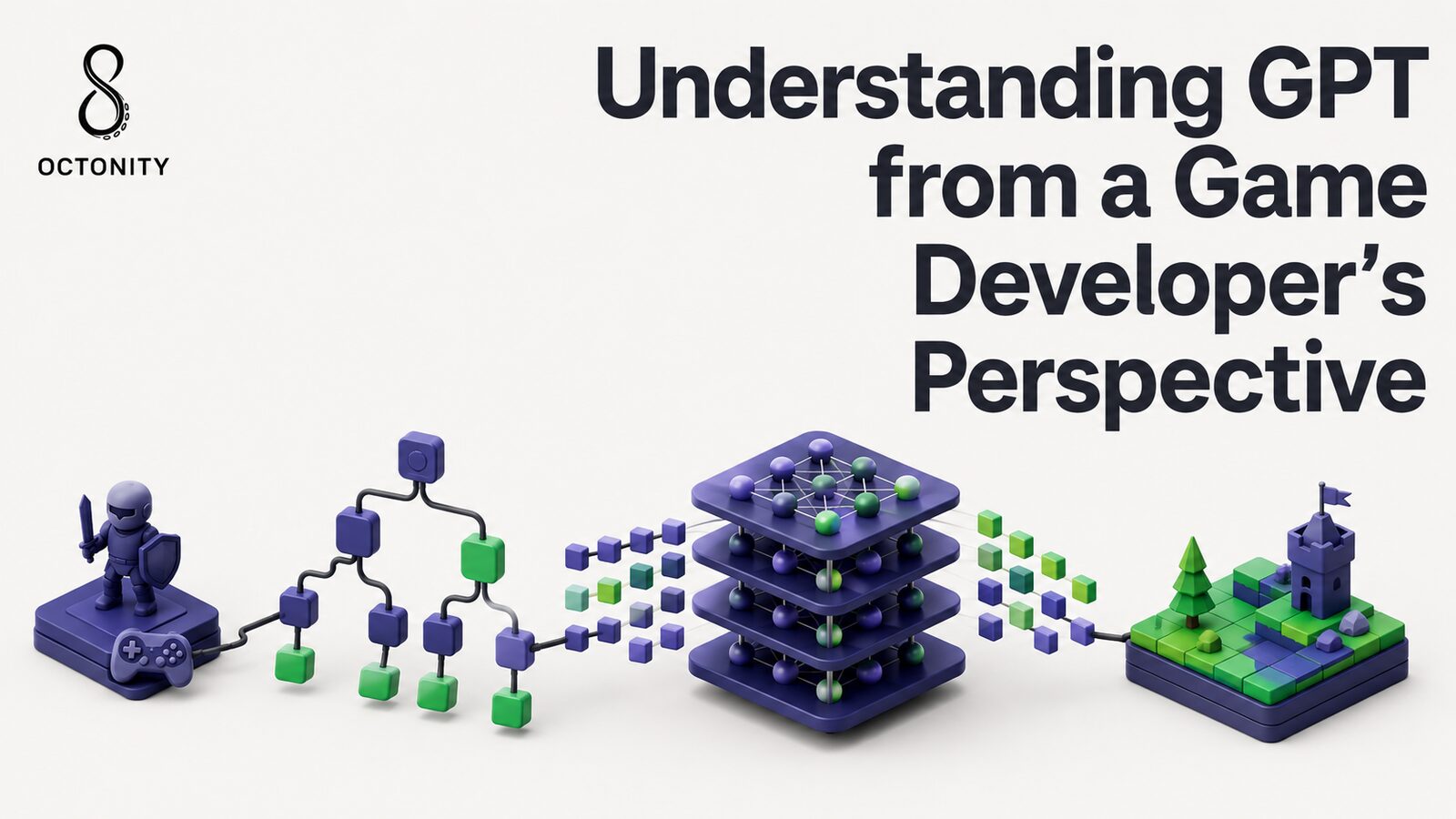
When developers first hear about GPT, Transformers, Attention, Embeddings, Neural Networks, and Large Language Models, it can sound complicated.
But if you already understand vectors from game development, GPT becomes much easier to understand.
At a simplified level, GPT is built from ideas like:
Vectors
Dot Products
Weighted Averages
Softmax
Probability
These are not completely foreign concepts. Game developers already use similar math for movement, direction, enemy vision, steering, and collision systems.
GPT predicts the next token.
Example:
Ali likes ___
GPT may predict:
cats
The simplified flow is:
Text
 ↓
Tokens
 ↓
Vectors
 ↓
Attention
 ↓
Softmax
 ↓
Next Token Prediction
A 2D vector is simply two numbers:
Vector2 position = new Vector2(3, 2);
This means:
x = 3
y = 2
In games, vectors can represent:
Position
Direction
Velocity
Acceleration
Example:
Vector2 direction = new Vector2(1, 0);
This means:
Move right
The dot product measures how much two vectors point in the same direction.
Formula:
A · B = Ax * Bx + Ay * By
Example:
A = (1, 0)
B = (1, 0)
Calculation:
1 * 1 + 0 * 0 = 1
Meaning:
Same direction
Another example:
A = (1, 0)
B = (0, 1)
Calculation:
1 * 0 + 0 * 1 = 0
Meaning:
Perpendicular
Another example:
A = (1, 0)
B = (-1, 0)
Calculation:
1 * -1 + 0 * 0 = -1
Meaning:
Opposite direction
Change the vectors and watch the dot product — the same operation GPT uses to compare meanings.
static double DotProduct(double ax, double ay, double bx, double by)
{
    return ax * bx + ay * by;
}

double result = DotProduct(1, 0, 1, 0);

Console.WriteLine(result); // 1
With arrays:
static double DotProduct(double[] a, double[] b)
{
    double sum = 0;

    for (int i = 0; i < a.Length; i++)
    {
        sum += a[i] * b[i];
    }

    return sum;
}
In games:
Vector = position or direction
In GPT:
Vector = meaning
Example:
likes = (0.6, 0.1)
cats  = (0.7, 0.2)
car   = (-0.5, 0.9)
Dot product:
likes · cats
=
0.6 * 0.7 + 0.1 * 0.2
=
0.44
Dot product:
likes · car
=
0.6 * -0.5 + 0.1 * 0.9
=
-0.21
So mathematically:
likes is more related to cats than car
This is the same dot product idea, but instead of comparing directions, GPT compares meanings.
Suppose the sentence is:
Ali likes cats
And the current word is:
likes
GPT asks:
Which words should I pay attention to?
Use simple 2D vectors:
Ali   = (1, 0)
likes = (2, 1)
cats  = (2, 2)
Now compare likes with every word.
likes · Ali   = 2
likes · likes = 5
likes · cats  = 6
So we get scores:
Ali   = 2
likes = 5
cats  = 6
These scores are called attention scores.
But they are not probabilities yet.
Softmax converts raw scores into probabilities.
Formula:
Softmax(xᵢ) = eˣⁱ / Σ(eˣ)
Input:
[2, 5, 6]
Output:
Ali   = 1.33%
likes = 26.52%
cats  = 72.15%
Meaning:
When GPT processes "likes", it should mostly focus on "cats".
Add tokens, change their scores, and watch softmax turn raw scores into probabilities.
The interactive demo above uses this logic:
function softmax(values) {
  const max = Math.max(...values);

  const expValues = values.map(value =>
    Math.exp(value - max)
  );

  const sum = expValues.reduce(
    (total, value) => total + value,
    0
  );

  return expValues.map(value => value / sum);
}
The max part is used for numerical stability.
Instead of:
Math.exp(value)
we use:
Math.exp(value - max)
This prevents very large numbers from causing overflow.
using System;
using System.Linq;

class Program
{
    static void Main()
    {
        double[] scores = { 2, 5, 6 };
        string[] labels = { "Ali", "likes", "cats" };

        double[] probabilities = Softmax(scores);

        for (int i = 0; i < scores.Length; i++)
        {
            Console.WriteLine(
                $"{labels[i]}: {probabilities[i]:P2}");
        }
    }

    static double[] Softmax(double[] scores)
    {
        double max = scores.Max();

        double[] expValues = scores
            .Select(score => Math.Exp(score - max))
            .ToArray();

        double sum = expValues.Sum();

        return expValues
            .Select(value => value / sum)
            .ToArray();
    }
}
Output:
Ali: 1.33%
likes: 26.52%
cats: 72.15%
After Softmax, GPT has probabilities:
Ali   = 0.013
likes = 0.265
cats  = 0.722
Now it combines the word vectors:
0.013 * Ali
+
0.265 * likes
+
0.722 * cats
This creates a new vector.
The word likes now contains information from:
Ali
likes
cats
This new vector is called a contextual embedding.
At the end, GPT creates scores for possible next tokens.
Example:
dog = 2.1
cat = 5.8
car = 0.4
Softmax converts them:
dog = 2%
cat = 97%
car = 1%
GPT chooses the highest probability token:
cat
So the output becomes:
Ali likes cats
This article is simplified.
Real GPT also has:
Query vectors
Key vectors
Value vectors
Multi-head attention
Feed-forward neural networks
Layer normalization
Residual connections
Many transformer layers
Billions of learned parameters
But the foundation is still:
Vectors
Dot Products
Softmax
Weighted Averages
Probability
No.
GPT is powerful, especially for text, reasoning, summarization, code, and language tasks.
But classic machine learning is still very useful for:
Fraud detection
Price prediction
Churn prediction
Risk scoring
Recommendation systems
Anomaly detection
Structured business data
For example, if you have transaction data:
Amount
Country
Device
Customer age
Transaction count
and you want to predict:
Fraud or not fraud
A classic ML model like:
Logistic Regression
Random Forest
XGBoost
LightGBM
may be faster, cheaper, and easier to explain than GPT.
For a game developer, GPT is not magic.
It is mostly:
Vector math
+
Probability
+
A lot of training
The same math used for:
Movement
Enemy vision
Steering
Direction checks
also appears inside modern AI systems.
The difference is what the vectors represent.
Game Development:
Vector = position or direction

GPT:
Vector = meaning
Once you understand vectors, dot products, and Softmax, the foundation of GPT becomes much easier to understand.
Plan, create, and publish across every channel from one workspace. Free plan available — no credit card.
العربية ليست لغة واحدة بل لهجات متعددة. نشرح لماذا يحتاج الإشراف الذكي إلى فهم كل لهجة على حدة بدلاً من الترجمة المسبقة.
Translating a comment to English before moderating it loses the slang, the dialect, and the intent. Native-language moderation is the only thing that holds up at scale.
A practical guide to building a social media approval workflow: draft-to-publish stages, roles and permissions, client sign-off, and how Octonity handles it.